

RGI Editorial ·
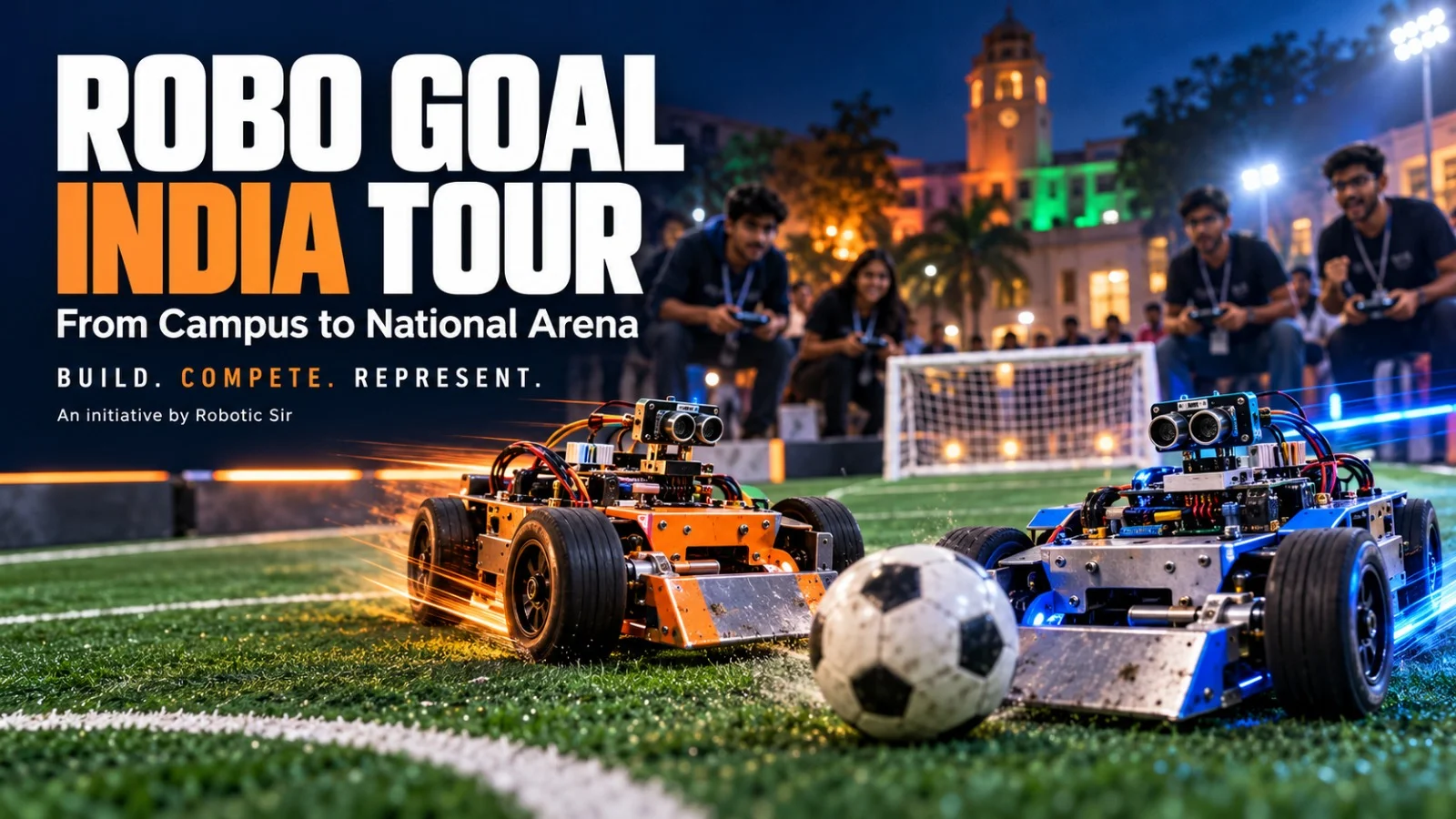
Have you ever wanted to play football but didn’t want to go out onto the pitch? Or have you ever wanted to play football but with robots and having control over all their moves?
That’s where Robo Goal India comes in!
The Robo Goal India Tour has been created by Robotic Sir to bring competitive robot soccer to students in schools, colleges and universities. It combines robot soccer with robotics, coding, engineering and the competitive nature of playing football.
This gives students the chance to get hands-on with their robots, improve them and solve any technical issues with them whilst also enjoying playing football.
What is Robo Goal India?
The idea behind Robo Goal India is to give students an incentive to build robots.
They will design and build their own robots to play soccer with whilst also improving upon their electronics and control systems. They will also experience many of the same issues engineers face when designing machines.
Even a simple soccer robot uses many different engineering aspects:
- Mechanical design – Designing a stable, light chassis.
- Electronics – Using motors, motor drivers, batteries and control circuits.
- Coding – Creating movement and control systems.
- Wireless – Creating a reliable remote control.
- Testing and Debugging – Identifying technical issues and improving the robot.
- Match Strategy – Understanding how to position, attack, defend and work together.
These concepts are interesting to learn as they have to be combined to create a working robot.
From the Campus to National Level
One of the main ideas behind Robo Goal India Tour is to create a competition structure that starts from individual institutions and allows students to move up to bigger opportunities.
The structure would be:
1. Campus Qualifier
The first step of the competition.
Schools, colleges and universities can get involved in holding a robot soccer competition at their institution. Students will compete in teams, building their robots and getting them ready for competition.
This can be their first experience of a robotics competition and gives colleges an opportunity to get students involved in practical engineering.
They won’t just have robots in the lab, they will get to see them in action.
2. City & Regional
Teams that are eligible will get the chance to compete against students from other institutions. This will bring a new challenge as they will be facing robots that are different.
They will also be able to share ideas.
Whether they will be able to compete in these rounds depends on the official competition structure and qualification criteria.
3. National League
The vision behind the national league is to create a network of student robotics teams.
The teams will be ranked and will have profiles. They will also have highlights from their matches and stories from participating institutions.
This gives students an incentive to keep improving their robots.
4. National Championship
The ultimate goal of Robo Goal India.
This will bring together the best teams from each region/institution.
To get to this point they will need to have a well prepared robot with improvements and reliable performance. They will also need to make quick decisions during matches.
This is what Robo Goal India wants to give students the opportunity to do.
Robo Goal India 2026
This idea was put into action with the 2026 Robo Goal India championship.
The offline national championship took place on the 27th September 2026 at Dome Area, Spectrum Metro Mall, Sector 75, Noida.
There were two categories, Junior and Senior.
Prior to the championship there was:
- Technical Workshop – 20th September 2026
- Practice Session – 26th September 2026
On the day of the championship they had:
- Robot Verification
- Robot Preparation
- Live Matches
- Competition Rounds
- Final Matches
- Awards Ceremony
This gave students the chance to put their preparation into practise.
How Did The Matches Go?
There were two types of matches in the 2026 Robo Goal India.
3v3 Qualification Matches
The qualification matches were played using 3v3 on a large pitch (720x720cm).
Due to there being three robots per team, students will need to think about how they are positioned and working together. They will need to work on attacking and defending.
Whilst having a fast robot can be an advantage, students will need to understand how their robots are working together and how to adapt.
1v1 Final
The final was a 1v1 match played on a smaller pitch (240x240cm).
This meant students needed to focus on their robot’s movement. Accuracy, speed, reliability and control were very important.
As there were two robots there wasn’t much room for error. Any issues with positioning or control could affect the outcome.
What Skills Will Students Learn?
What’s interesting about robot soccer is that students rarely work on one subject.
They will need to understand how their robot works by combining mechanical parts, electronic circuits, coding and control systems.
Some skills they will learn are:
Mechanical Engineering
They will work on designing the robot chassis, positioning the wheels, choosing materials and ensuring the robot is stable.
Electronics & Circuitry
They will learn about batteries, motor drivers, controllers, switches, wiring and managing power.
Coding & Logical Thinking
They will create commands for their robot to move and control. They will also learn how to identify why their robot isn’t responding and how to fix it.
Teamwork
Teams will need to work well together. They will divide roles, discuss their designs and work as a team during matches.
Testing & Debugging
They won’t always get it right first time. They will need to test different setups, identify issues and improve.
Confidence & Innovation
They will gain confidence in their technical skills and decision making by presenting their work and competing.
These skills can be used in future academic projects, engineering and other tech related activities.
Guest Speakers & Judges
The 2026 Robo Goal India brought together guest speakers and judges from many different areas of academia, research and technology.
Guest Speakers & Judges:
- Mr Surya Prakash Mishra – Associate Director, DRDO, SAG Lab (Chief Guest)
- Mr Ravi Kumar – YouTuber (Mr. TECH BOX)
- Dr Rajneesh Kashyap – Professor, IIT Delhi
- Dr Rohan Kumar – Professor, IIT Delhi
- Mr Tejas Prataprao Chavan – Subject Matter Expert, Newton School of Technology
The championship was also supported by many organisations and sponsors:
- Newton School of Technology
- WAB Coffee Co. | Spectrum Mall
- Snow Village Noida
- Chai and Chill 75
- Mr. TECH BOX
Robo Goal India 2026 Winners
After playing the matches it was time to celebrate the hard work of the teams and individuals.
Results:
Senior Category
- 1st – Literacy India 1 – £20,000
- 2nd – Literacy India 2 – £10,000
- 3rd – Team Zalvrik – £5,000
- Best Bot Design – Rehan Malik – £2,500
Junior Category
- 1st – Team Be a Robonaut – £20,000
- 2nd – Tanishq Gupta
- Best Bot Design – Ayush Golas – £2,500
They were given cheques, trophies and certificates for their merits.
All teams contributed to the competition. They all put in hours of preparation, testing and technical problem solving.
Well done to all the winners and participants!
Why Should My School/College Hold A Robo Goal India Campus Round?
Holding a robotics competition can be a great way to get students interested in technology.
A campus round will give students the opportunity to get hands on with something, compete with others and see their technical skills in action.
There are many reasons why institutions may want to hold one:
- Hands on experience – Students will get experience building, testing and using robots.
- Increased Engagement – Robot soccer can get students interested in engineering, electronics, coding and technology. This can include students that wouldn’t usually take part in traditional technical competitions.
- Increased Visibility – Approved institutions will have increased visibility.
- Increased Innovation – These kinds of activities encourage students to be experimental, work as a team and think outside the box.
- More competition opportunities – Eligible teams may qualify for the next rounds depending on the official rules for the season.
- Increased Digital Exposure – Some matches, interviews and robot building stories may be featured on the digital journey of Robo Goal India.
This will give students an opportunity to get hands on with robotics.
How Can My Institution Hold A Robo Goal India Campus Round
If your school, college or university are interested in holding a campus round you can request to do so via the official Robo Goal India site.
An authorised representative from your institution can provide the following information:
- Institution Name & Type
- Campus Location
- Contact Information
- Number Of Students Expected
- Preferred Date & Time
- Venue Information & Other Questions
Once this has been sent, the Robo Goal India team will look at the request to see if they can accommodate. They will consider factors like venue availability, location planning, number of people expected and if it can be done.
This does not guarantee that an event will happen. The date, responsibilities, financial and operational aspects will need to be discussed and agreed.
Interested in holding a Robo Goal India campus round?
Visit the official website:
Find out more about the initiative and how institutions can hold one:
https://roboticsir.com/robo-goal-india-tour
Taking Robotics Beyond The Classroom
Often students will learn engineering topics in isolation. They will learn about electronics, understand mechanical systems and code solutions. However, getting all of these to work together can be a whole new experience.
This is what makes robot soccer interesting.
Students will need to investigate why their robot isn’t moving as they want. Consider what they can improve when they lose a match. And see the direct impact of their design working.
This gives students an opportunity to build, improve and compete.
The 2026 championship in Noida was an important step in giving students this experience. The wider tour aims to take this even further by connecting institutions through campus rounds, city & regional rounds, a proposed national league and national championship.
What’s interesting is that the next team to make their mark may be from an institution that hasn’t even held their first qualifier yet!
The next amazing robot soccer team could be built at your institution!
Are you ready to build, compete and represent?
Robo Goal India Tour
Build. Compete. Represent.
Initiative by Robotic Sir.
FAQs
1. What is the Robo Goal India Tour?
The Robo Goal India Tour is an initiative by Robotic Sir to bring robot soccer competitions to schools, colleges and universities. It connects campus competitions to a larger competition.
2. Who can take part in Robo Goal India?
Students from eligible institutions can take part depending on the rules.
3. What is a campus qualifier?
A campus qualifier is a robot soccer competition held at an approved school, college or university. It gives students the opportunity to compete within their institution.
4. Can students from the campus qualify for national competitions?
Eligible top performing teams may qualify for city, regional or national rounds depending on the official rules for the season.
5. What skills will students learn?
Students will gain hands on experience with mechanical design, electronics, coding, motor control, testing, debugging, teamwork and match strategy.
6. How can my school/college hold the Robo Goal India Tour?
An authorised representative can request to hold a campus round through the official website. The Robo Goal India team will look into the details.
7. Is Robo Goal India just a football competition?
No. Whilst it is a robot soccer competition, students will also gain experience with engineering, electronics, coding, problem solving and teamwork.